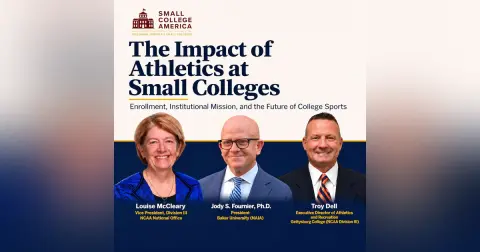
The Impact of Athletics at Small Colleges Webinar



 RSS Feed
Welcome to this live edition of Small College America and our Consequential Conversations series. I’m Dean Hoke, joined by my co-host Kent Barnds. Today we’re discussing “The Impact of Athletics at Small Colleges.” Athletics can shape enrollment, campus identity, the student experience, and the finances of smaller institutions. We’ll look at both its value and the decisions college leaders are facing as the landscape changes.
Kent: We are joined by three guests who bring distinct perspectives to this conversation.
Louise McCleary is Vice President of Division III at the NCAA. She has spent more than 14 years at the NCAA national office, and before that worked for roughly 25 years on college campuses, including Vassar College and Elms College. She brings both a national and a campus-level perspective.
Dr. Jody Fournier is President of Baker University, a private university in Baldwin City, Kansas, and they are affiliated with the NAIA. He became president in July 2025 and brings the president’s perspective on the role of athletics in enrollment, mission, and institutional strategy.
Troy Dell is Executive Director of Athletics and Recreation at Gettysburg College, his alma mater. Before returning to Gettysburg, he spent 18 years as director of athletics at Frostburg State University and helped lead its transition from NCAA Division III to Division II. He brings the day-to-day operational perspective of an athletic director.
Kent: Louise, Jody, and Troy, welcome to Small College America.
Dean: We’ll begin with opening questions for each panelist and then move into paired conversations. Please send your questions throughout the program; Kent and I will ask these questions as time allows.
Athletics webinar November 5, 2026
Welcome to this live edition of Small College America and our consequential conversation series. I'm Dean Hoke. I'm joined by my co-host, Kent Barnes. Today we're discussing the impact of athletics at small colleges, which is a very interesting topic. We've had a lot of requests for this type of webinar. Athletics can shape enrollment, campus identity, the student experience, and the finances of smaller institutions. We're going to look at both the value and the decisions college leaders are facing as the landscape changes. Ken. Right.
A couple of just housekeeping things for all of our participants and registrants. This is a recorded webinar. We will be posting it next week on the Small College America website. So we just want to make sure that you are aware that this is being recorded. Second, this is a webinar format rather than a meeting format. So you can see us; we can't see you. But we are also using the Q and A function, which should be at the bottom of your screen. There is a Q and A function, which we will be monitoring throughout the webinar, in order to facilitate Q and A and answer your questions. This is rather than the chat.
The chat is actually exclusive just to the participants or the the panelists. But we do welcome you to use the Q and A. Dean, and I will be monitoring that and direct your questions to the correct panelists throughout. We will reserve some time at the end of the webinar for questions if we are not able to get to all of them through the time that we're together. But today we are joined by three guests who bring very distinct perspectives to this conversation about small colleges and athletics. We're joined by Louise McCleary. She is the vice president of Division III at the NCAA.
She spent more than 14 years at the NCAA National Office, and before that worked for roughly 25 years on college campuses, including Vassar College and Elms College. She brings both a national and a campus-level perspective, and we're delighted to have Louise with us. Our second panelist and guest is Dr. Jody Fournier, who is president of Baker University, a private university in Baldwin City, Kansas. Baker is affiliated with the NAIA. He became president in July of 2025 and brings the president's perspective on the role and importance of athletics in enrollment, mission, and institutional strategy. We're delighted to have President Fournier with us.
And our final panelist today is Troy Dell, who is the executive director of athletics and recreation at Gettysburg College, his alma mater. Before returning to Gettysburg, he spent 18 years as director of athletics at Frostburg State University and helped lead its transition from NCAA Division III to NCAA Division II. He brings the day-to-day operational perspective as an athletic director who has to manage budgets and people and programs. Louise, Jody, Troy, welcome to Small College America. We're glad to have you.
Well, we're going to go ahead and begin with opening questions for each panelist, and then our format will be: after that, we'll move into paired conversations. But we thought we'd give them a little bit of time. To answer some initial questions that we have, so do remember, if you do have questions while we are on the air, make sure to send them to us through the question chat, and we'll be watching those for you. Well, let's go ahead. And Louise, why don't we begin with you? Division three institutions are facing many of the same enrollment and financial pressures confronting small colleges in general.
From your national perspective, what are the most significant challenges facing D3 athletes today for both the athlete and for the school?
Yep, Dean. Well, it's a pleasure to be here. As Kent mentioned, I've been doing this for over 30 years, and I think the higher education pressures that small colleges are facing today are the greatest I've seen in my 30 years. You have an enrollment cliff. You have changes in federal loan policies. You have more regulations around international student athletes. You have all of that impacting enrollment numbers. You also have changes in state regulations, and those are just a few of the issues facing our colleges and universities. And then you have to layer in that our small colleges are still recovering from the pandemic. That has smaller budgets.
You have a current economic environment where, every time you send a team on the road, food costs are higher, and transportation costs are through the roof at the moment. And that impacts every athletic team trip. And so, what you have is you have small colleges that have these athletic departments that have smaller budgets, and they're trying to stretch those budgets to make sure they're meeting the needs of their student-athletes and their athletic teams, which are the key for many of our small colleges to their enrollment drivers. Not only are they filling their athletic teams, but they're filling their beds, they're filling their classrooms, and there's not necessarily more budget dollars or support staff to fix that issue.
And so I think, in my opinion, from my national lens, the greatest threat is this financial instability, but it's coupled with athletics as an enrollment strategy. And this reliance on athletics for students to fill the classrooms, to fill the beds with decreasing budgets—that, to me, that breaking point is one of the greatest threats. That is what our small colleges have: how do we balance that moving forward in this current environment when there's such a reliance on recruiting new students, not just student athletes, to our institutions?
Very good, Kent.
Thank you, Louise, for that perspective. Jody, I'm going to turn to you. Jody, at Baker, athletics is important, a part of the institution's identity and enrollment strategy. As a college president, how are you balancing athletics contributions to enrollment with institutional finances and the educational mission and the overall student experience?
Yeah, great question. And Kent and Dean, thank you for the invitation to be here today. I'm delighted to be here. Louise really framed it up really nicely. The headwinds are strong. The challenge is here for small privates. The financial sustainability is front and center, and athletics, as you said, Kent, plays a major role in enrollment. As well as financial sustainability for Baker, we must balance it with the student experience, and we must balance it with the educational mission of the institution. It is not a binary choice; they have to go hand in hand. And I'll say that without athletics, we have multi, I mean, almost a hundred-year tradition of.
Athletics at the institution—it is not a new move for the institution. Without athletics, I'm not sure what the financial shape of the institution would be. Having said that, you know, we're doing things to make sure that we have non-student athletes here, but it amplifies our brand. It communicates the student experience that one could expect to have here. It serves as a marketing tool, a marketing element at the institution to talk about what one could expect while being here. It also extends our geographic reach. I think without the ability to have sports help us bring in student athletes from around the world, we would be a very different campus, and that.
That really provides a unique experience on campus for everyone: faculty, staff, students, community members. So we're very thankful for that. Seventy-four percent of our undergraduate population is comprised of student-athletes, so it's something you absolutely feel when you're here. The student experience in terms of game day experience, you know, there's a lot right now in the higher ed literature about. Students choosing flagship institutions, Big Ten schools, the SEC experience for game day, and we have a hundred-year-plus tradition of fraternities and sororities. And if you come to campus during the week, especially on the weekends, it feels like a mini version of a Big Ten experience.
It's really built into the fiber of the culture of the institution here. Faculty, staff, non-student athletes—they show up to these events. They show up for one another. So it's very powerful. It's a powerful part of our identity and really makes the place special, which I think you know leads to more students and leads to more opportunities at the institution. We want student athletes here, but we want people just to be on campus, and that brings in people from, you know, all areas.
The other thing I'd say in terms of the educational mission is that we are looking right now at the AAC&U value rubrics around durability skills, employability skills, the skills that employers are looking for beyond the major that a student has, and we're we're recognizing that those outcomes, those learning experiences, happen outside of the classroom. So it's not unique. It's not. We have academics, and over here we have athletics. Athletics help deliver, help introduce, help reinforce, and demonstrate mastery in things like being able to communicate effectively, being able to use data to make decisions, being able to form a team and work on a team. So athletics goes hand in hand with mission and financial sustainability. As well as our educational mission.
Very good. Brian, let's turn to you. You're probably the true practitioner. You're the one on the ground, as it were. And I know you used to be a wrestling coach, and that's not a good thing either. But I would say that, particularly, you've worked in institutions both D two and D three. And so you have a wealth of experience. And what has changed most about running a small college athletics program, and what challenges do ADs face today? And the presidents and the trustees that may not fully appreciate that part of the world.
So again. Just want to echo what my, you know, other colleagues wanted to say: thank you for having me, Dean Kent. Really appreciate the opportunity to share my perspectives. You know, I think we're where the rubber meets the road, right? So all the promises we make to students and alumni and families and parents and so on and so forth. The athletic director is responsible for delivering on those promises, right? So, what is the actual student-athlete experience? How do we integrate across campus? How do we hit our enrollment numbers? We're expected to help with the advancement side of things, right? Promoting college revenue through that piece.
You know, our athletes are involved with our alumni and career placement with workforce and all of those types of things. So it's really, I think, the challenge that maybe gets overlooked a little bit is that obligation to deliver on the promises that we make during the recruiting process across campus. You know, I think some of the other things that probably get missed. Is the fact that because we're such type A people in this business, we are committed to overcoming whatever the obstacle is, right? So I always tell my staff when I meet with them, they gave us a problem to solve because we can do it. So let's figure out how we overcome that, how we put it together.
A plan that accomplishes the goal in the best possible way, and we've done that for so long in intercollegiate athletics that it's just expected of us. You know, and when you tie back to some of the things that we've already discussed with some of those pressures, that gets harder and harder to do on a regular and ongoing basis. You know, so just that kind of general deliver on the promise. How do we do it with all the other pressures? Um, and that expectation that we've always done it, so why can't we do it again? Right? You win again, Troy. Win, you know, or win, win again, coach.
Um, and we all know, like, it's tough to get to the top, but darn, it's really hard to stay on top once you're there.
How true is that?
Isn't that the isn't that the truth? And that's a pressure probably everybody in your position feels, as well as your staff. So, um, President Fortier, I want to ask a little bit about your experience at Baker. So many small colleges, and I think you said 74% of Baker's student undergraduate students or student-athletes rely on athletic recruitment for tuition revenue and other revenues. In our preparatory conversation, you indicated that Baker is paying much closer attention to contribution margins by sport. How do you determine whether athletics is genuinely contributing to the institution's financial health, rather than simply increasing enrollment? And as a representative of the NAIA, you have a little bit of a different formula than the Division Three institutions on this.
So we'd love to hear your perspective on that and how you're measuring that. And really illustrating that measurement to the rest of your campus community.
Yeah, thanks. Thanks for that question. And having come from a D3 school, I worked at Capital University for almost three decades, and we were—it's a very different model. And it's been a pretty sharp learning curve being here at Baker. But you know, some of the core fundamental principles around fiscal responsibility hold true, and so I took a page from the work that the team that I supported before engaged in looking at academics and other related areas in terms of contribution margin and finding ways to make adjustments and making sure that, you know, headcount was really something that was sustainable. We've applied some of those principles here.
So we, when we look at new programs that we're going to launch, whether they're academic or a new team, we do a very thorough pro forma, financial pro forma, and we do a version of that with our existing programs. So the way we ensure that headcount really translates into something that's sustainable is we try to really at a very micro level. Account for every single point of revenue that's coming in related to the student-athlete and athletics in general, not just the student-athlete and tuition, and also all of the costs and sometimes hidden costs that you might not see in the athletic department's budget, right? So it's all about net tuition revenue and net revenue.
So on the student side, the student-athlete side, we have to make sure that we are scholarshiping using a strategy. And I don't think that was always the case, at least at this institution. So we work very closely. When I say we, I mean athletics. The athletic director, myself, and student and strategic enrollment management are now working very closely, monitoring every single letter of intent that goes to a student-athlete to make sure that we are maintaining discipline and executing a strategy around bringing in blue-chip athletes, which we're willing to invest. This is an incredible tool. But we have to make sure that we're not over-scholarshipping, that we're not under-scholarshipping, that we're actually creating a class that is financially sustainable.
So that coordination between strategic enrollment management and athletics is critical.Right alongside is retention, persistence, and completion. So the athletic director and the coaches are intimately involved in student success work, academic success work at the institution, because as everyone knows, you know, it's it's cheaper, easier to keep a student many times than to recruit a student, and that is incredibly challenging. In the current landscape and in AIA, even though there is no transfer portal officially, we're living in a world of a conceptual transfer portal. So that is something that we really work hard to try to break that cycle and make sure we're doing everything to keep students happy and at the institution.
And then, of course, you look at staffing and equipment and officials, and as Louise said earlier, the increasing cost of travel and meals and some other things that don't always hit the budget would be like early arrival meals, meals over breaks when others aren't around, and food service is not around. At the same time, there are other revenue generators that often aren't appearing on the line items in an athletic budget. So advancement opportunities, bringing in donors through the door of athletics, even though it may not go back to athletics. So all sorts of opportunities there. Marketing, which I mentioned earlier. And really, I think the way that you maintain all of this, everything I've mentioned, is very spreadsheet-driven.
But I think presidents and leaders should really resist evaluating athletics solely as a collection of individual teams, or athletics being an appendage to the institution. I think we really need to work hard to bring athletics more directly into strategic planning. Resource allocation at an institutional level. I think most schools, our school, have an athletic director on the cabinet. They're embedded in strategic enrollment management. As I said, they're embedded in student experience work. They're embedded in academic affairs, which I didn't mention. I think we need to expect that they're a major player at the table, making sure that we're all working together to contribute to institutional enrollment goals, financial performance, retention, advancement, community engagement, the whole of the years.
Well, thank you, Troy. One of the reasons that we had you as a guest is, well, first because you're a Gettysburg alum, as am I. But one of the reasons that we were really attracted to you is because you, as the athletic director, executive athletic director, report up through strategic enrollment management at Gettysburg. And in recent years, or in the last year, you've been there just a little over a year. Gettysburg has been considering adding new athletic programs as a driver of enrollment. We'd love to know, from your perspective, what institutions should be examining before adding a new program.
And from your experience, what are the costs and operational demands that are most often underestimated when contemplating adding a program, oftentimes because they're trying to drive the moment? Love your perspective on that, Troy.
Yeah, so I think first and foremost, you have to do some level of assessment of what you're currently offering, right? So what? What quality of program are you currently delivering to the individuals that you've already brought to your campus and already, you know, in sports that are already established? And make sure that those pieces are properly funded, properly resourced, that the student-athlete experience is of a certain caliber of what you're trying to achieve, right? And every institution is going to be different on what that expectation is and what they're expected to deliver from their clientele.
You know, I think the next piece then is trying to make sure that you build a plan that then mirrors what you've already got in place. Or, you know, in a lot of cases, when I've done this, it probably early on exceeds what you've got in place for some other things because you've got an opportunity to ask, and you've got an opportunity to sell new things. So I think that is, you know, really the starting point. So, what do you currently have? What are you trying to do? You know, I think some of the things that.
That you have to also think about: are you adding emerging sports, or are you adding established sports that already are in the NCA portfolio? Because those are a little bit different in their costs, right? So go and build a successful program in the emerging space. And you're covering your transportation and your meals and everything to championships. Um, you know, in the NCA space, there's a reimbursement there that helps you do that. So, um, you know, that's just one kind of nuance piece. Are you okay with waiting for an emerging sport to develop? Right? Are you okay with, you know, supporting that? Do you have the time to make sure that?
You know, you're getting on those sports meetings and making sure that you're supporting whatever organization is leading that, so that they can be successful, and so that the sport actually does come to be a member. I think a lot of people will pick a sport and they'll say, okay, it brings 35 new student athletes to my campus. That's the number I'm looking for. Without even really making sure they understand the difference between those two pieces, you know, you get into the kind of standard easy check boxes, right? So how does it impact athletic training staff, strength and conditioning staff, equipment room, you know, spaces on campus and stuff like that?
Making sure that you have those, or you have a plan. You know, what is the travel footprint going to look like? Again, getting back to the emerging versus established, does your conference have that sport? If it doesn't, then you've got to go out and find associate opportunities that help you keep the geographic footprint reasonable for your travel. So I think those are some of the key things that you want to look at. You know, I think you talk about meals over break, right?
There's an unforeseen expense that, if you are new to a sport and you haven't planned for it, all of a sudden you go hire the coach and the coach says, "Well, yeah, we can come back on dot dot dot day, and we want to be here." Have you planned for that? Have you really thought that through in all of your process? And you can really overlook that one really, really quickly.
Before we come back to you, I want to remind our audience who's out there that if you do have questions, please feel free to ask through the chat box, the Q and A box. I'm sorry, and we'll make sure to get those in as best as we can. But I'm not quite done with you yet. I still have a question for you, and in particular. I'd like to be able to ask about one of the strengths, really, of small college athletics: that students can compete without participating fully while they're able to participate fully in athletics and campus life.
I'm not so sure that in the big-time sports you can really do that in the big time D1 at times to be able to have that full experience. What do student athletes gain from this experience, and how can the colleges make a stronger case for its own value, including the skills that they carry into their career?
Yeah, so I think one of the questions that came up in every panel I met with when I was interviewing for this position is, how are you going to integrate intercollegiate athletics into? The campus fabric, Troy, right? So how are athletes going to tie back to the rest of the overall experience? Um, and that, on a day-to-day basis, is something you've got to work on. Um, we try to do a lot of things here where we are bringing other departments on campus into our staff meetings, talking to our coaches.
About the programs that they deliver across campus, making sure that there's awareness and a connection, and then, you know, making sure that we can get our student-athletes, you know, exposed to those and involved. You know, the other thing that I think is important is telling your story. Right, so we're constantly doing things, whether it be on a service platform, right, so community service type things where we give back, or an engagement platform, right? And I think they're really unique. I learned the difference when I went from three to two, right, when I was trying to get my sack involved, and so on and so forth. The D2 platform is a little bit different.
And the expectations for how you interact with the community. So, regardless of which one you're doing in that space, track what you're doing, knowing what your student-athletes and coaches are doing, and then telling your story. Tell it internally. Tell it externally. You know, the other things that you get in this proposition are. You know, the standard things that we've been preaching about in athletics for a long time: leadership, time management, resilience. Right, those are the things that employers want. We do a lot of work here, integrating our student-athletes and our teams with, you know, our alumni who are in different fields out there in the marketplace, making sure that.
They're aware of internships, making sure that, you know, they've got career mentors and those types of things. That really, really connects us with that group of folks as well. So I think it's about being deliberate every day. It's about being open-minded to partnering with other departments on campus. And I'll be completely honest. We've got our student-athletes stretched as thin as we possibly can because everybody would like five minutes with them because of how motivated they are and the fact that they are engaged and that they're goal-oriented and all those types of things. So that becomes a challenge for those young people every day.
Very good. Luis, by the way, one of the things I want to say to any of our panelists. As we're asking questions, if you have additional comments you'd like to be able to add in there, please feel free to do so. But I do have a question for you, and that is: you described in our earlier conversations a push-pull. Institutions need athletics for enrollment and retention, but may lack the resources to support the experienced students and families now. As the world stands, can D3 institutions protect that experience while losing sight of their educational mission?
Yeah. So the very short answer is yes, for sure. And I always like to level set. And I say this a lot whenever I speak. As much as we talked about an enrollment cliff, there are still today eight million high school student-athletes. And so, in Division III, we have about 210,000 student-athletes, all told in the NCAA, about 500,000. I do not know the numbers for the NAI, so I apologize. But the point I try to make is. Troy used the word that type " personality. I just like to say small colleges, Division Three, we're stubborn.
We know how transformational the opportunity to go to college is for 18- to 22-year-olds, and we know that athletics adds to that. And the fact that there are eight million high school student-athletes.Between five hundred and seven hundred thousand get the opportunity between the NCAA and the NAIA. It's a really elite club, and it's one that I think every small college wants to protect to be able to continue to give that opportunity. I'll speak from Division Three. I know we're providing an outstanding student-athlete experience, and I am going to make an assumption that the NAI is doing the exact same thing. And we know that because we survey our student-athletes and we ask them what's important.
And yes, they want to compete, but every survey we do says the number one reason that they're coming to a Division III institution is to get a degree and to graduate. And we know from other surveys that in Division III, we still are primarily teaching our student-athletes through in-person learning. Many in Division II and Division I have gone more online, and we value that. That's part of our philosophy: we're going to give you these great experiences beyond athletics and academics. And that's embedded into our philosophy, and our student-athletes believe in that. They demonstrate that, and their surveys back us up to say that's what's so important to them.
And I say all that because while Division III student-athletes want a competitive environment, they fully understand the educational mission that they're going to receive at a Division III institution. And type A, stubborn, however you want to describe it, Division III institutions, that educational mission is first and foremost. Now I say all that, Dean, and yet, as you have these students coming into our campuses and our colleges and our universities, there is a growing expectation of how they're going to be supported. Is it the youth sports culture? Is it the club programs? Is it the individual focus on specializing in sport?
I don't know, but many times there's an expectation to say, "Am I going to have more time with the coaches? Am I going to get strength and conditioning support? Am I going to get academic support? Am I going to get mental health support?"How am I going to travel? I'm expecting that I'm going to travel in a certain manner. I'm going to be fed a certain way. Um, and all of that adds a strain to campuses, athletic departments, and I think, and Jody said this. Small colleges need to be so strategic about what our roster size is going to be, what our travel policies are going to be, and what we're going to do in terms of making sure we're supporting our staff.
Think athletic trainers, been raised before. What are we going to do around retention? Because that's so critical. Because many student athletes come in, they compete their first year. And for a variety of reasons, they don't compete in year two or three. But if you've recruited them correctly and you're retaining them, they're going to stay and have a fulfilling career at your institution, even though they're no longer competing. And so, I'll conclude by saying I think small colleges need to preserve their educational identity. At the same time, adapting to today's challenging landscape within college athletics.
Thanks, Louise. I'm going to ask you a follow-up question, and then I'm going to actually ask each one of you to address one of the questions from our audience, and that is about the impact of the NCAA transfer portal on small college athletics. So I'm going to give you each sort of 30 seconds on your firsthand experience with that. But, Louise. You've mentioned a lot of things that are impacting small college athletics, but we've got some new things out there. And financial pressures have been there. The demographic cliff we've been talking about for at least half of my career, because you can't make an 18-year-old overnight.
All sorts of things, but we've got now the transfer portal, NIL collectives, the five years of eligibility, lots of things that kind of started at the Division I level, which are now trickling down and having an impact.At the small college level, whether it's NCAA Division III or NAIA, and then most recently, at least relative to Division III, a federal lawsuit was filed in late October challenging Division III's prohibition on athletic scholarships, without predicting the outcome of the case. What questions are raised by all of this and the kind of trickle-down effect on small colleges? Would love your perspective on that.
Sure. So, in Division Three, 460 institutions. Like many small colleges, we've had some closings; we've had some mergers; we have some who have decided not to. Support athletics anymore. Large institutions, smaller, high endowments, low resources, public versus private. We have it all, but the one common thread is that we just reinforced our philosophy statement a few years ago that says there is support. For our philosophy, not to award scholarships based on athletic ability, and I think that's something that every prospective student-athlete, every family, every guardian, and coaches know, helping them make those decisions. Know that's part of our philosophy. We've been.
Very upfront with that to say this is what helps us create our unique Division Three experience, and so I think many choose, right? I mentioned 210,000 choose to come to Division III. Some don't. And then regarding the other pressures that you have said regarding NIL, the transfer portal, you know, age-based eligibility. That's something that our membership, and what I love about our membership, is that they're really thoughtful to say, "Let's talk through this to see if that's right for us and the Division Three experience we're trying to provide." Sometimes the answer is yes. That makes sense for us to go in that direction. I know we're going to talk about the transfer portal, but we've just recently passed legislation to say.
It actually makes it easier for our compliance officers, if any Division III student-athletes are looking to transfer, to enter them into the transfer portal. Before, we had about every institution could do their transfer slightly differently, and that was causing more confusion and administrative burden. So we just changed to have everybody say, if there's going to be a transfer, you need to use the transfer portal. We continue to look at name, image, and likeness. We know that it is not as prevalent in Division Three as the other two divisions, but we know it's coming. So how do we create the right framework for our student-athletes, our coaches, and our administrators?
So, and the age-based eligibility, we're going to talk about this January, and again. We have to figure out what is right for Division Three and that unique experience we provide. And it's always difficult to have those conversations based on all the pressures we've talked about in the first 30 minutes of this podcast, right? Because sometimes when you're under the gun, or you're under financial pressure. You maybe don't get to make as distinct a decision as you would if you weren't under those pressures.
Thanks, thanks, Louise. And I'm going to sort of break in before we ask the next question. And I would just love Troy and Jody's perspective. Jody, I know that NAIA doesn't have the transfer portal in the same way, but I recognize that just its existence is changing behavior. So we'd love to know on the ground what is happening with this kind of swirling of student-athletes because of the availability of the transfer portal. Jody, we'll start with you, and then we'll go to Troy.
Yeah, with the NAIA, you would think it is very far away from the portal, and yet it is very real on our campus. There is no NAIA portal. A student cannot go in and enter their name in any way, shape, or form. And yet, we have students pretty frequently saying, "I'm going to enter the portal." And I think what that means to them, and what it means to me, is that there is a mindset now that I've had really remarkable success at Baker, in the classroom, out of the classroom, performed really well, and feel the competition for my sport. I'm gonna level up. I'm gonna go somewhere else. Someone else is gonna, you know, it's gonna.
The grass is greener on the other side, and I'll tell you, there are a handful of students. I've not been here that long, but a handful of students I'm aware of have gone on. They've moved into, you know, a different school, only to wash out. I don't think they understand that you have to worry about. Your classes articulating, and the credits going, and program requirements, and it—I think we need to do a much better job as an institution, and I'll speak only for Baker, and maybe others will feel the same way, of explaining to the students how this works and what the real expectations are, and align expectations with reality.
And as Louise said before, the ultimate goal of the student-athletes, I think for most, is to get a degree and to move on to something after the college experience. And I think we need to dig in more to that. We need to focus, as Louise said, on retention. And Troy said before, you know, weaving academics into the student experience. We need to give them secondary reasons for being at the institution, tertiary reasons. I'm not smart enough to know the next term to indicate four reasons at the institution, but we need to work really hard to let them see that the end game is really about them and their success and not necessarily leveling up in sport.
That's great. Thanks for that perspective, Troy. How about you? What what's the the on the ground at at Gettysburg as you think about the transfer portal?
Well, so I think one place that maybe a lot of people don't pay attention to is what happens when a coach moves on, right? So it has, in my mind, changed how you hire coaches, especially at maybe institutions that were a little bit slower, and you would save some budget dollars on lapsed salary and those types of things. Um, you know, at the at. At certain levels, you've now got to get right in the marketplace, and you've got to move really expeditiously, or else some of your kids will get antsy, and they'll start to look around. It's not so much maybe here at Gettysburg, but at my last institution, if I turned over a football coach or a basketball coach.
The portal started to fill up quicker than you know I could; I could move the search along, and then you're back recruiting an entire team in a really short window of time, which deviates from, you know, the mission and value of the institution, right? Now you are looking at a different group of clientele. You've lost the kids that you've spent. You know, 12, 18 months cultivating relationships with through the recruiting process. So the evaluations of character and fit and all those things, when you get into the transfer portal and those kinds of quick turnover spaces, really can change the dynamic and how your team fits into your campus community.
Really appreciate that perspective. So we're going to combine two questions for President Fournier about the kind of differences that you experienced from Division Three to to NAIA. And whether or not there are special challenges or things that you really view as a strength therein, and then also just some practical tips, perhaps, on how to manage the financial pressure. How do you work with your athletic director to make sure that you're delivering on the experience for student-athletes, but also doing it in a fiscally responsible way?
Yeah, um, when I came to Baker, I thought, you know, this is manna from heaven, having the ability to get a scholarship in athletics, you know. And as I mentioned earlier, the grass is not always greener on the other side, and that was true for me as well. Now, I should say that there are incredible advantages to the NAIA in general. It's a great conference, a great organization. For scholarship student-athletes, it's a game changer. If, on an affordability front, it's amazing. It really does bring a new, you know, level of dollars to the game that can get more students to the institution that maybe you aren't able to do, you know, without.
I'll tell you, in a D3 environment, we were competing against other D3 schools and other D2 schools and NAIA schools, and we couldn't get scholarships. So the financial implications of that were that we had to try to level up in terms of wraparound services and athletic training and a better training room and strength and conditioning and facilities, and that's extremely costly. So there are advantages. The biggest challenges I would say that I face personally are, and I've said it a couple times, the importance of strategy and scholarship. That, you know, it really is about net tuition revenue and ultimately net revenue. We can't afford all blue-chip athletes. I said that before. Not here at Baker.
So we have to make really difficult decisions about which sports we're going to identify as being able to compete for national championships, and which ones do we want to have winning seasons. You know, I don't want to say it's a tiered system, but we have to make strategic decisions about our level of investment. It's extremely costly, and it's not just an affordability issue that we're addressing for students. There are students who could be, you know, I would say, able to be full-pay students, but it's that psychological consumer behavior. Feeling valued, which we are; it's an impact award. We want students to come in and make an impact. We give them out for ROTC.
We give these awards out for leadership and also for athletics. We want these students to come in and shape the institution, but it can be really costly, and I'm not sure it's addressing affordability in all cases. The other thing I'd say is it's challenging with the board of trustees and other decision makers at the institution, where they question: Do we need scholarships? Maybe only give, you know, two scholarships out of all of athletics, and shouldn't people want to pay to be here? Because if you look at high school, people will spend thousands of dollars every year for club sports at their high school. And we should be charging them extra to come, and it's complicated, right?
The scholarship environment is complicated. And then, I'm sorry, the second part of the question: can't we?
The second part of it really is a resource. How you work with your athletic director to make sure that you're making wise and sustainable choices when it comes to travel and program investment.
Let me take it to a very practical level. The biggest issues that I interact with the AD on to really try to control costs and make this work out would be, as I think Louise said in the very opening, travel, the cost of diesel, and the cost of gasoline. It's brutal right now, and so we have to look at things like, can we be more strategic with non-pre-conference travel? Can we? Be decisive and try to put money away for post-season travel, and that's often something that I found wasn't budgeted for here properly, so that can be really costly. Staffing, we've looked at, and I know other schools that have done this, combining positions.
You know, we have an individual who's the head of athletic training who also coaches one of our teams. We have individuals I know of that work in the admissions office, but also are an assistant coach. So we're finding efficiencies. Our SID does a lot of game-day work, which is not sustainable, but we're trying that out for the moment. When we look at, and there's a lot of discussion of new teams, all the considerations that Troy mentioned before, pro forma, does it make sense? What is travel going to look like? And then the other thing that we're looking at is really trying to be aligned, the AD and I, on voting properly within the conference for conference expansion.
We really have to watch as other schools are thinking about joining the conference. We need to make sure they're not too far away. I'm just going to be really honest. So we don't have an overnight stay. We don't have to get buses instead of vans. So those are some of the top-of-mind, very pragmatic things we're working on.
That's great. I know Dean's got a few questions. We're probably going to adapt a little bit because we've got some excellent questions in the Q&A from the audience. But Dean, you want to ask the next question?
Well, actually, coming to you anyhow, Louise, I want to ask you about what you mentioned: mental health. You brought that up in the conversation. How is student athletes' mental health and student development supported? If budgets for those areas, and how is that? How is that limited in some ways, or are they?
They're absolutely limited. So coming out of the pandemic, I think everyone experiences this, and especially at small colleges. What we are hearing from our student athletes and our national student athlete advisory committee, as well as our institutions, is that mental health was a top five issue. Coaches were spending more time on addressing mental health than just about anything, and so Division Three took the steps a couple of years ago to say, could we create? A collaboration with somebody who provided mental health resource assistance beyond everything we were doing out of our sports science institute, and in April of 2025, we signed an agreement with Mental Health First Aid. And so, Division Three and Division Two just started it this year.
Every institution in Division Three or Division Two can get training for up to 30 individuals to help them identify when a student-athlete is having a mental health concern. Now the trick is it's a three-year certification, so it's been great. We've had over half of our division already participate in the program. So you have coaches who, one, are learning more about their own mental health needs, finding ways to support their student-athletes. Sort of the next level is that our campuses don't have counseling centers that can support not only the student-athletes but all the students. And so many campuses, and Jody can probably talk more about this, are trying to figure out how to say.
Do we then have telehealth? Is there a local hospital, a local clinic? Because we don't have the counseling department size and resources to serve everybody on our campus. But to help with the initial cost in Division Two and Division Three, we have set up this collaboration to say we will help jumpstart. We'll pay for that initial training because we know that to get recertified, the fees go down to less than twenty dollars a person. And so we've tried to take that concern we heard and say, now let's go make a difference, understanding that it's a top five need, but there may not be the budget dollars behind it.
I'm gonna, as you can imagine, we're getting a ton of questions, which is great. But I want to mix up a little bit on what we were doing on the schedule. And this one, Troy, Jody, this is to you. And don't make it brief. Get in your words, but we're also going to be cognizant of time. How are Gettysburg and Baker? Preparing for the adoption of five seasons of competition in recruitment and goal setting, what impacts are you already seeing on your campuses? I'm going to go with Troy first, then Jody.
Yes, so I talk regularly with the vice president that I report to. Who is the vice president for enrollment and education services? About how do we find partners on campus on the faculty side who may be willing to start graduate programs or introduce graduate programs into our academic offerings? Would love to see that piece. If we don't get those, then we will be in the business of helping kids find that year, that fifth year of opportunity. And I think this whole thing is going to be really interesting. You know, Louise talked about the legislation that's on the docket for January. I don't think enough people paid attention to how this became part of the Division Two landscape.
Because there is a pathway that doesn't require membership voting on some of the different pieces of, you know, legislation, bylaws, etc., so that'll be very interesting, but we are talking about it. We're hopeful that, you know, we'll get some academic programs, maybe that we can keep some of our kids, or be able to get some fifth-year kids who decide that they would like a Gettysburg experience, or maybe they played or went to a Patriot League school or another FCS school and were you know a five minute a game kid and now they could come here and be a.Thirty-minute a game kid on our soccer team.
Very good, Jody. Let's hear your side of it.
Yeah, so the NAIA just yesterday adopted the five-year rule, and we saw we had a second-mover advantage. You could see that it was moving in this direction. There were some straw polls over the last year, and so we started preparing, actually last year. We have invested heavily in market research to develop a number of new programs, largely graduate programs, to complement the programs we have that have market demand. As I said, student demand, employer demand, room in the competitive landscape. And what we did wasn't a big change of direction, but we ensured that we could ladder all of these programs.
Four plus one, you know, three plus two, those sorts of opportunities, which I think would have been a great idea anyway. But we know this can be a real positive under this new, under the new landscape. And right now we're gearing up for launch in a number of these programs. We think that would be helpful to address the potential need. The one question that we still have that we're still wrestling with and modeling out is: it looks like some other schools in the NAIA will be extending undergraduate scholarship into the fifth year, and we're trying to get our arms around that. I would love any advice from anyone that's listening, watching.
I'd love to talk to you offline if you have some good strategies.
I'm very good. Very good. So I want to ask a couple of, yeah, go ahead, please.
Of the other questions that have come in, because we really do have some good questions from the audience, and there is a likelihood we might go a little bit beyond the hour for both those who are participating and our panelists. But we'll try to end shortly. So. Troy, I think that probably both Troy and Jody: this is a question about recruitment goals for teams and expectations. Whether at your institution or in your mindset, whether they're more influenced by enrollment needs.Or by what is realistic and accomplishable based on roster sizes and financial support. How do you get that balance right?
And Troy, I'll start with you because I know that you probably have to wrestle with that all the time. And then Jody would love your perspective on that. How do you get that balance right between the enrollment needs and then what's realistic, what's doable?
Yeah, so I think it's a blended approach. You absolutely have to understand the environment of your institution. I think there's always a back third of a roster, right, that are probably kids who are program kids or kids who maybe aren't going to play as many minutes or are there for. You know, as practice, or you know, some of those types of things. So what I've always tried to do is understand where the coach thinks the sweet spot is for them on, you know, roster size, what the other institutions are doing, and then what we're trying to do here at Gettysburg is be, you know, two, three, five kids higher.
To help support the enrollment side of things, I am not a big proponent of this kind of what folks are calling developmental teams and those types of things. I think it's really even hard to play a JV football schedule in today's space. So I think it's about. Having full rosters that we can manage and that we can give kids some opportunities, but it's a blended approach for us.
Great, thanks, Troy. Jody, how about your perspective on that?
Yeah, totally, totally agree. I think we're really trying to get much better at being strategic across the institution, and this is one area in particular. I think we've had an over. I know we've had an overreliance on. Getting to the end of the enrollment cycle, the final phase of the funnel, and then saying, "Okay, we're going to need you to take on X more per team, or who can get more, go get more." And then, even being here a short time, you see the results. They come in, and they leave right away. It does. You can't support a good-quality experience. So we've worked hard, talking to coaches through the athletic director, to find out what it is.
In your opinion, the optimal, not in terms of workload, which I appreciate and I understand, and we don't want to burn people out. But the way I approached it was, what staffing would you need? Like, to get to another level, what would that look like to invest? And for me, that's the gauge of okay, this is where we can provide a good experience. And I'm not saying we invest in level up because, as Troy said, I'm. The JV developmental league is there, but there aren't enough that are doing it in our area to have robust, equitable seasons compared to the varsity sports yet. We're working on that.
So we're trying to take the pressure off of athletics by doing new things for non-student athletes, many new things. And when we set the goals, I think this was the actual question. The goal is based on optimal roster size, informed by, directed by athletics, and then it's not being directed by budgetary need.
Louise, I want to come back to you with a question I've been meaning to ask you, and it's particularly looking across Division III. What are the opportunities for the institutions and the conferences to work together more effectively? For example, scheduling shared services or other approaches to preserve the student-athlete experience while trying to control costs.
Yeah, I think one of the greatest stressors, and Troy can talk about this, is filling your non-conference schedule and not traveling hundreds of miles to do that, which may require a more expensive bus transportation to get you there or an overnight, and so on. What we've started to really have conversations with our Division III conference commissioners is: you have the collective value and impact of the national office, but you also have it as a conference. Are there ways to work with regional bus companies to, say, pool all of our scheduling to maybe get a better deal? Are there ways to find similar discounts if you're looking at everybody buying soccer balls and basketballs and volleyballs?
Are there ways to use the conference to do that? How do you use your collective scale to provide that quality student-athlete experience, but also be more financially fiscal? And the last thing I would say is, many of our Division Three conferences—it's also happening in Division Two—are starting to sign contracts with third-party vendors around live streaming. Those are real dollars that are coming into those conferences and those institutions to help offset something. Like live streaming, that's going to increase their brand and marketing of their institution.
And Louise, one of the participants, asked questions about licensing and branding apparel, and how that also has an impact on recruitment and enrollment. Also, those are revenue options. Those weren't previously available for small colleges, which are today, and I think that probably any athletic director, president, or athletic advisory board is going to be looking at things like that. In our Q and A from our participants, we have a new athletic director who's asked a number of different questions about both building programs and. Also, how do you create a sustainable identity? And I'm hopeful that maybe Troy would be willing to take some of those questions offline.
If Bernard, if you'd like to reach out to Dean and to me through the registration, we will connect you with Troy, who's an experienced AD, and I think he can probably answer some of those questions if you're willing, Troy. A couple of things, maybe just to bring us home, that I think would be useful for this discussion. There's a great question, which I think probably each of the three of you might have a perspective on, and it's this: it's common at small colleges that we have staff members who wear a lot of hats. A big part of the success of these athletic programs is having staff who truly have bought in. They're wearing the gear every day.
They believe in the program and mission, and would love just maybe a little bit of perspective from each one of you, fairly briefly. How do you prevent staff burnout while still getting the job done when you do have staff who wear lots of hats? And I know, Louise, you've seen it from a number of different perspectives. So how do you go last on that? But maybe, Troy, we could start with you. How do you prevent burnout?
Well, I think some of it is being flexible. With folks, you know, understanding who has families, who, you know, lives an hour away and commutes in because it works for their family dynamic, and you have maybe some flexibility there with when they're in the office, when they're not in the office. You know, we spent the better part of almost two years doing everything through this medium right here, right? So virtually, we can do a lot of stuff on a day-to-day basis, um, and not have to be in a room together all the time. Now, there are certain times when it makes a lot of sense, but I think that's one way, um.
You know, I think the other, another way is making sure that coaches have the resources they need to do their job, right? So if they're getting on the road and they're going to be recruiting, let's not make it any more difficult, right? Let's make sure that they have, you know, per diems to be able to eat a decent meal, and that they can stay at a hotel and they don't have to, you know, have a friend in the area to be able to stay at their house or live at their, stay at their parents' house or all of those things are things that I've heard in the past, you know.
So, trying to make sure that those resources are appropriate helps with burnout as well. Making sure that you're there to support them when they've got.Challenges with student athletes, parents, alumni, right? You've got to be a resource. You've got to take their call. You've got to sit with them and help them work through the problems that they're experiencing on a day-to-day basis. If they're on an island by themselves and you don't provide them that kind of coaching and that kind of space to sound off on and find the right answers, they will burn out. Young folks will leave the profession. You know, the other one that's really challenging is young mothers, right?
And we lose a lot of really, really fantastic female coaches when they become mothers and start families because we haven't quite found out how to make that palatable for them.
Thanks, Troy. And quickly, Jody and Louise, and then I think we'll probably turn to Dean to close us down after a wonderful webinar. But Jody, any hints on helping prevent burnout?
Yeah. In addition to, you know, lightening the load, making life easier, removing obstacles, as Troy pointed out. The other thing I would say is just recognizing the work that people are doing. I know it's obvious, and I'm sure everyone does this, but. It goes a long way to tell people how much you appreciate them and let them know that you see that they're doing extra work and wearing multiple hats to use the questions, you know, the root element of the question. Aside from that, some things that I find are just wise to do: it leads to better decision-making, is making sure that these individuals are asked what would make. Things better, right? What would make things easier?
And try to fold that into a larger strategic conversation. So, people, if you're going to work a plan and you're going to implement change, or you're trying to optimize whatever it is, performance, outcomes. People need to be a part of creating the plan and see themselves in the plan. And I think talking about what would make their life easier and trying to deliver on that, but help them get a seat at the table and a voice at the table. The more people feel like I'm not just here working, but I'm here working towards a greater good, that goes a long way. I know I appreciate that.
Yeah, as we're wrapping up, it's been touched on that culture building is so important. But at the end of the day, our athletic administrators, coaches, staff, especially athletic communicators and athletic trainers, are probably working 70 to 80 hours a week. And really, to solve this nut, we have to figure out how to say you shouldn't be working 70 to 80 hours a week. And we haven't gotten there yet because of all the pressures we talked about an hour ago. And that, coming out of the pandemic, athletic trainers are probably the biggest issue in Division III. They learned that they could go work at Amazon or Lilly or somewhere else and work five days a week and 55 hours. And they miss athletics.
They miss that connection with student athletes and coaches. But we have an environment that's not healthy, and we haven't quite figured out the nut to crack to go. I don't know if we should, you know. Yes, you're for the team, and we need this. That you still should be asking them to work 80 hours a week. Um, and they are consistently, and. Troy's nodding his head, so I haven't been on campus for at least 14 years. But when you're in it, you're in it. But at some point, you go, that's not the right model for us to sustain what we're trying to do for our student-athlete experience.
Well, thank you.
Well, I think we are out of time. As a matter of fact, we've been out of time for a little bit, but we wanted to stay with this. Louise, Jody, and Troy, thank you so much for sharing your perspective. And I want to give a special shout-out to the people who have been registered and attended this session. You asked some great questions. There's one question there I just wanted to ask, but I knew it would take an hour and a half to be able to answer the question. So I decided we had to pass on that, perhaps another day. So again, thank you to everyone. We've had relevant questions. It's been just outstanding.
So on behalf of Kent Barnes and me, I want to thank you very much, and we hope you've been enjoying the series. It will be available next Tuesday. Just check on smallcollegeamerica.net. Thank you, everyone.


