Mergers, Acquisitions and Reinvention: What Small Colleges Need to Know


 RSS Feed
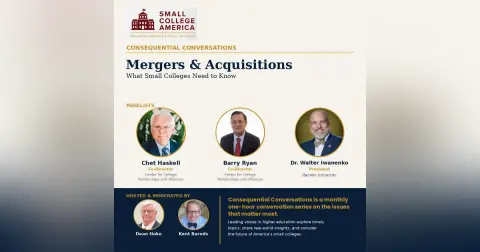
 Welcome everyone to this special edition of Small College America and the first of our Consequential Conversations series. I’m Dean Hoke, and I’m joined by my co-host Kent Barnds. Today’s conversation is “Mergers, Acquisitions and Reinvention: What Small Colleges Need to Know.”Mergers and partnerships are no longer subjects that small colleges can afford to discuss only when they are in trouble. Today we want to look at when institutions should begin considering their options, what makes these efforts work, what can cause them to fail, and what presidents and boards need to know before circumstances narrow their choices.
We have three panelists who bring both direct institutional experience and extensive work with colleges considering partnerships, mergers, acquisitions, and other forms of reinvention. Let me briefly introduce them:
• Chet Haskell, Co-Director of the Center for College Partnerships and Alliances, brings extensive higher education leadership and experience with institutional partnerships, mergers, and acquisitions.
• Barry Ryan, Co-Director of the Center for College Partnerships and Alliances, has worked with institutions on partnerships, mergers, acquisitions, and other strategic options for colleges facing change.
• Dr. Walter Iwanenko, President of Gannon University, has spent more than two years leading the Gannon-Ursuline College merger and brings the perspective of a sitting president navigating the process in real time.
Question 1 - When Should the Conversation Begin? One of the themes we want to explore today is timing. If an institution waits until it needs a merger or partnership to survive, has it already waited too long? What signs should tell a president and board that it is time to begin seriously exploring strategic partnerships, mergers, or other alternatives?
Question 2 - The Gannon-Ursuline Experience. Walter, you have been living this process for more than two years. Take us inside the Gannon-Ursuline merger. What brought the two institutions to the table, what made you believe the combination could work, and what have been the most important lessons so far? Barry, from your experience, what stands out to you about the conditions that make a merger like this possible?
Question 3 - A Merger Is Not the Only Option. When people hear that a small college is considering collaboration, they often jump immediately to merger or closure. But there is a much broader range of possibilities. What options should institutions be considering before a full merger, and how does a college determine which level of partnership or integration best fits its circumstances?
Question 4 - Boards, Presidents, Mission and Culture. These decisions are about more than finances. They involve governance, institutional identity, mission, alumni, faculty, staff, and community. What roles should the president and board play in beginning and managing these conversations, and how do you protect mission and culture while still being willing to make significant change?
Question 5 - Why Promising Partnerships Fail. Not every promising partnership or merger succeeds. From what you have seen, what are the most common reasons these efforts break down? Are the biggest obstacles financial, cultural, governance-related, personality-driven, timing—related, or something else?
Question 6 - What Should Leaders Do Now? Let’s close the main discussion by looking forward. If you were speaking privately with a president or board chair of a small college that is stable today but concerned about the next five to ten years, what would you tell them to be doing now to preserve the greatest number of options for the institution’s future?
Question 7 - Quick Insights. I’d like each of you to give us one brief answer. What is one thing you wish more presidents and trustees understood about mergers, partnerships, or institutional reinvention? Please keep it to about 60 seconds each.
Additional Questions from Audience
Close


