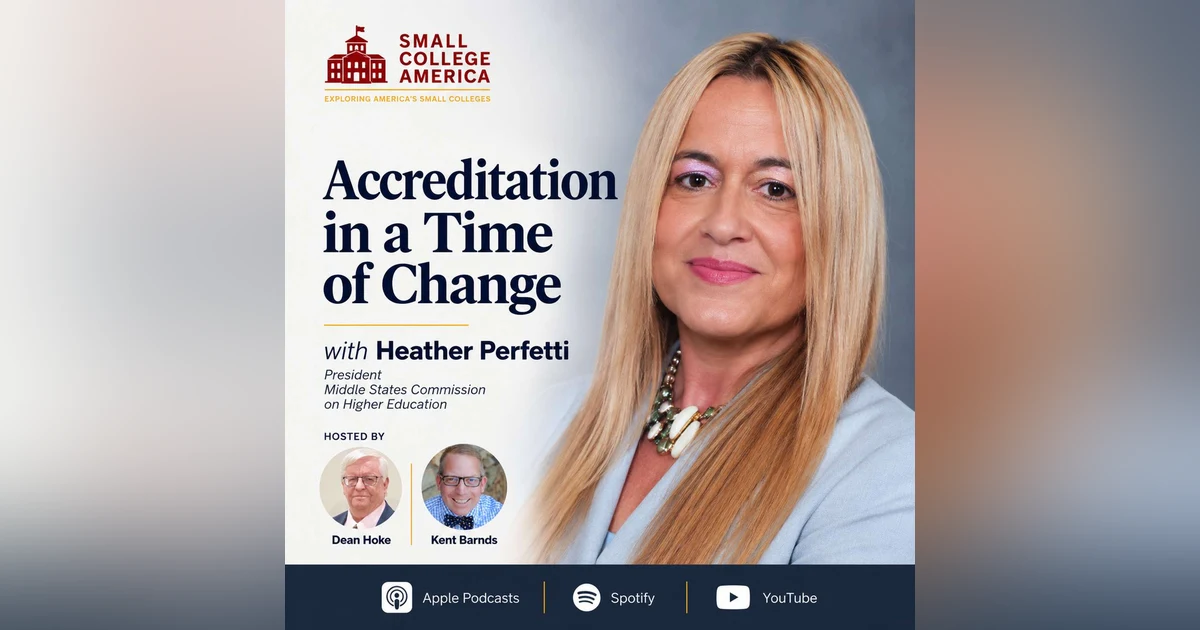
Accreditation in a Time of Change


 RSS Feed
 Kent Barnds: “Welcome to Small College America, a podcast dedicated to exploring the role and value of small colleges in the higher education landscape. I'm Kent Barnds, Executive Vice President of Augustana College, and I’m joined by my co-host Dean Hoke, Co-Founder of Edu Alliance Group.”
Dean: Today, we’re joined by Dr. Heather F. Perfetti, President of the Middle States Commission on Higher Education. Heather has served as a faculty member, chief academic officer, accreditation peer evaluator, and in several leadership roles at Middle States before becoming President in 2020. She has also been actively involved in national accreditation policy and federal rulemaking.
Heather, welcome to Small College America. I understand that when you're not thinking about accreditation, the Delaware beaches—and two Chihuahuas—provide a pretty good change of pace.
Kent: Question 1: Heather’s Journey — Seeing Accreditation From Both Sides
Heather, before we get into some of the major changes taking place in accreditation, I’d like our audience to know a little more about you. You’ve been a faculty member, a chief academic officer, a peer evaluator, and now president of Middle States. How have those different experiences shaped the way you think about accreditation and what institutions need from an accreditor?
Dean: Question 2: The Changing Accreditation Landscape — Why Middle States Left C-RAC
Recently, Middle States announced it is leaving the Council of Recognized Accrediting Commissions, to to pursue broader partnerships. Can you tell our audience more about the Council of Recognized Accrediting Commissions and why you and Northwest decided to withdraw now?
Kent: Question 3: Federal Rulemaking — How Significant Are These Changes?
You participated in the federal negotiated rulemaking process, and we now have proposed regulations that could significantly change accreditation. When you look at the entire package — student outcomes, transfer credits, faculty oversight, institutional costs, and changes affecting accreditors themselves — which provisions concern you most, and which might actually improve the system?
Dean: Question 4: Financial Stress — When Should the Accreditor Enter the Conversation?
Small colleges are dealing with declining enrollment, tighter margins, and in some cases serious financial stress. From an accreditor’s perspective, what are the warning signs that an institution may be moving from financially challenged to genuinely at risk?
Kent: Question 5: Mergers and Partnerships — The Part People Underestimate
When we met, you made an interesting point: the legal transaction in a merger can actually be the relatively straightforward part. The more difficult work can be integrating services, curricula, and institutional cultures while honoring each institution’s legacy. What role does an accreditor play in helping institutions navigate that process?
Dean: Question 6: Five Years From Now — What Does Accreditation Become?
Let’s close by looking ahead. Five years from now, with more competition among accreditors, new federal requirements, AI, changing demographics, new credentials, and continuing financial pressure on institutions, how different do you think accreditation will look from what we know today?
Closing
Kent: Heather, thank you for joining us and for helping us better understand both the changing role of accreditation and what those changes mean for small colleges. We appreciate your perspective and your time.
For those listening or viewing, visit www.smallcollegeamerica.net to learn more about Small College America, find past and upcoming episodes, leave comments, and to subscribe.
Dean: On behalf of our guest, Heather Perfetti, my co-host, Kent Barnds, and me, thank you for joining us.


