Small College America Robert Kelchen


Dean Hoke: Welcome to Small College America, a podcast dedicated to exploring the role and value of small colleges in the higher education landscape. I'm Dean Hoke, and I’m joined by my co-host, Kent Barnds.
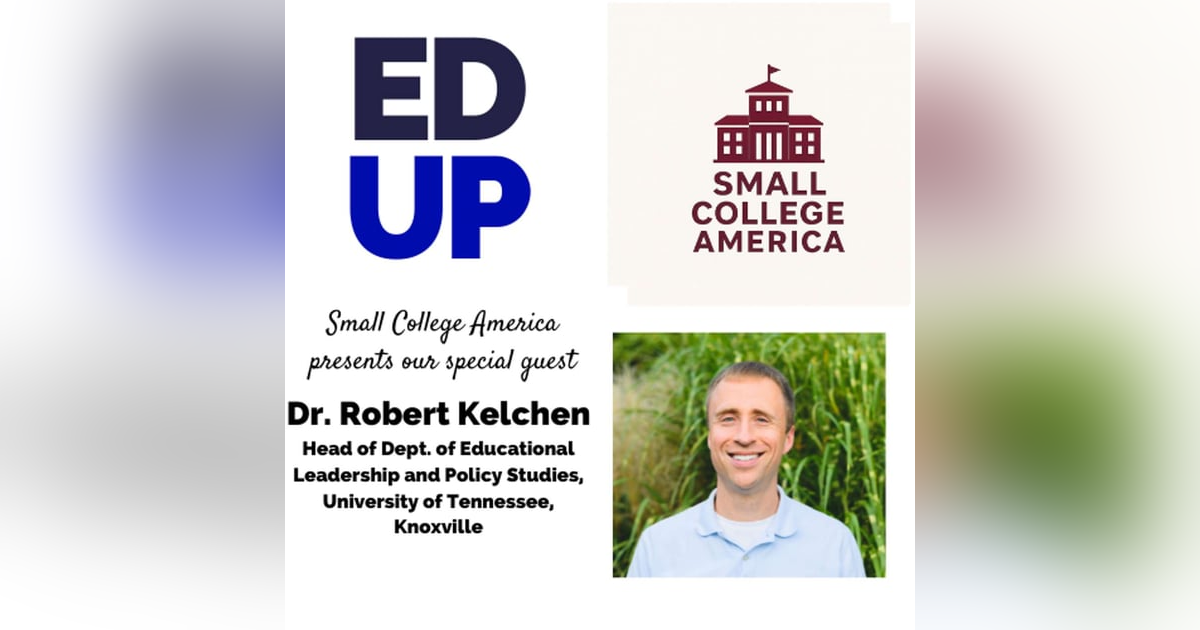
Kent Barnds: Robert Kelchen is a professor of higher education and head of the Department of Educational Leadership and Policy Studies at the University of Tennessee, Knoxville. His research interests include higher education finance, accountability policies, and student financial aid. Kelchen is the author of Higher Education Accountability and regularly publishes in top education journals. He has received the Robert P. Huff Golden Quill Award for excellence in financial aid research from the National Association of Student Financial Aid Administrators and has been recognized as one of the most influential faculty members in education by Education Week.
He is also the data editor for Washington Monthly magazine’s annual college guide and rankings. Kelchen holds a bachelor’s degree in economics and finance from Truman State University, a master’s degree in economics from the University of Wisconsin-Madison, and a PhD in educational policy studies from the University of Wisconsin-Madison.
Interview Questions (Estimated length: 27–30 minutes; six questions)
Q1: About Robert’s Background
Robert, before we dive into the data, could you briefly describe your work at the University of Tennessee—what you teach and research—and how that role shapes the way you think about institutional finance and risk—particularly for small, tuition-dependent colleges.
Q2: Recent IPEDS Research
Robert, you recently evaluated the newest IPEDS finance data (FY 2024) and dug into how often colleges lose money across sectors. You pointed out that the frequency of institutional financial losses is rising, especially among private nonprofit colleges. What does this trend tell you about the resilience of small colleges, and how should leaders interpret episodic versus persistent operating losses?
Q3: Early Warning Signs
In your work on financial stress indicators like operating losses, enrollment declines, and changes in endowment or state support, which combinations of metrics should small college leaders watch most closely as early warning signs?
Q4 Washington Monthly & Public Accountability
In addition to your academic work, you serve as the data editor for Washington Monthly’s college rankings, which emphasize outcomes and public value. How does that lens change the way you think about financial health and accountability—especially for small private colleges under pressure?
Q5: Board – Finances – Professional Development
What do you wish more boards of small private colleges understood about institutional finance—and where do boards most often misread or over-interpret the data in front of them?
Follow-up - Robert, what responsibility does college leadership have to ensure that boards—and especially executive committees—have the financial literacy and ongoing professional development needed to govern effectively in this environment?
Q6 The Next Five Years
Looking ahead five years, do you expect the number of financially distressed small colleges to stabilize, increase, or accelerate, and why?
Closing
Dean: Robert, thank you for joining us today and giving your thoughtful perspective on the challenges and opportunities facing small colleges at this pivotal moment in higher education. Your work helps bring clarity to conversations that can otherwise feel overwhelming for campus leaders.
For those listening or viewing, if you'd like to learn more about Small College America, go to our web page at www.smallcollegeamerica.net, where you can find details on upcoming episodes, contact us, and suggest topics you’d like us to cover.
This episode of Small College America is made possible with underwriting support from Edu Alliance Group — a higher education consulting firm that champions small colleges and the communities they serve.
On behalf of our guest, Robert Kelchen, my co-host Kent Barnds, and I, thank you for joining us.


