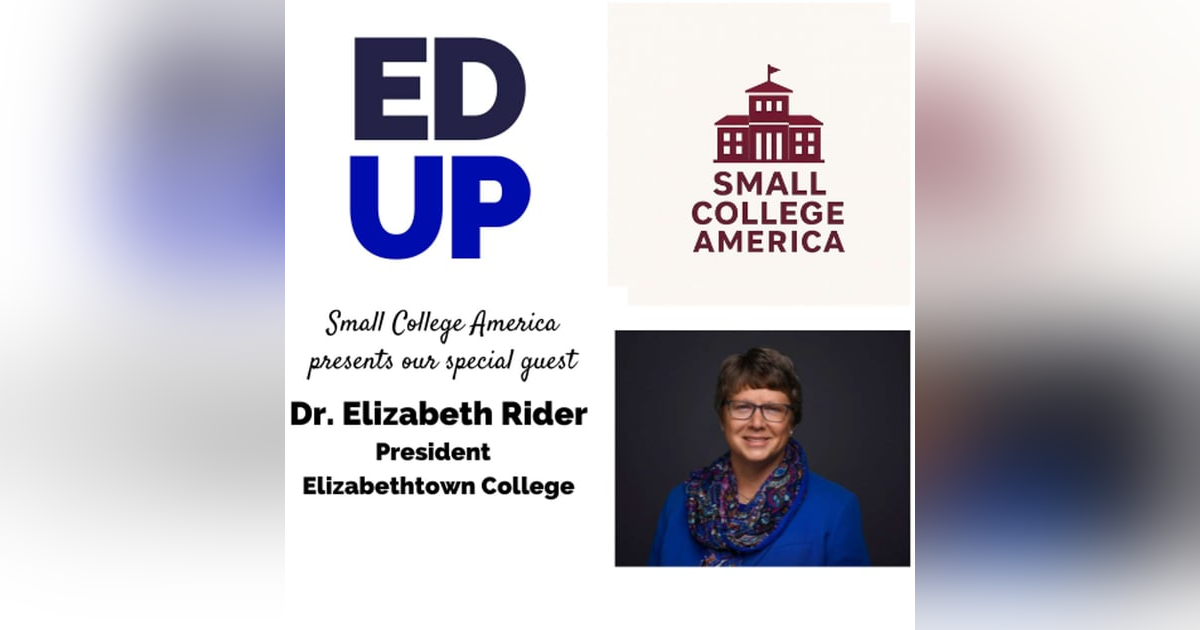
Small College America Elizabeth Rider - President Elizabethtown College



Welcome to Small College America, a podcast dedicated to exploring the role and value of small colleges in higher education. I'm Dean Hoke, and I’m joined by my co-host, Kent Barnds.
Kent Barnds: Our guest today is Elizabeth A. Rider, President of Elizabethtown College. Elizabeth brings more than 30 years of dedicated service to Elizabethtown, having served as faculty member, Provost, and Senior Vice President for Academic Affairs before becoming president in 2022.
Since becoming President, she has championed enrollment growth, and under her leadership, the College has surpassed fundraising goals and reached a historic endowment milestone of over $100 million.
She also serves as a member of the Board of Directors for the Association of Independent Colleges & Universities of Pennsylvania (AICUP), contributing to statewide efforts that advocate for independent higher education. Dr. Rider and I also share a personal connection — we’re both graduates of Gettysburg College — and I had the privilege earlier in my career of working at Elizabethtown College as well, so it’s especially meaningful for me to welcome her today. Betty, welcome to Small College America. We’re delighted to have you with us.
Dean - Betty, you’ve spent much of your career at Elizabethtown — from faculty to provost to president. How has that long institutional perspective shaped your leadership, especially during such a disruptive period for higher education?
Kent – Since becoming president, Etown has welcomed its largest incoming class in more than a decade and reached record applications. What changed — strategically or culturally — to drive that momentum, and how are you thinking about sustaining it in a competitive regional market?
Dean – Elizabethtown recently launched a dual-enrollment partnership with Lancaster Catholic High School, creating earlier pathways for students to earn college credit. How do initiatives like this fit into your broader enrollment and access strategy — and what role do K–12 and community partnerships play in Etown’s long-term sustainability?
Kent – Your draft Strategic Plan 2030 emphasizes integrating career-readiness across academic programs — including digital credentials and clearer pathways from classroom to career. How are you reimagining the student experience so graduates leave not only well-educated, but workforce-ready? Also, how do you communicate that value to prospective families?
Dean – Under your leadership, Elizabethtown has surpassed fundraising goals and reached a historic endowment milestone. What practical lessons can other small colleges take from Etown’s approach to its fundraising success and building confidence among donors and trustees?
Kent – Betty, looking three to five years out, what capabilities do you believe small colleges must strengthen now to remain resilient and relevant? And what encouragement would you offer presidents who may feel overwhelmed by the pace of change?
Also Betty, If you had to name one leadership priority for the year ahead, what would it be?
Dean: Betty, thank you for joining us today and for sharing such thoughtful insight into leading Elizabethtown College through a period of real momentum and change. We’re grateful for your perspective today.
For those listening or viewing, if you'd like to learn more about Small College America, go to our web page at www.smallcollegeamerica.net, where you can find details on upcoming episodes, contact us, and suggest topics you’d like us to cover.
This episode of Small College America is made possible with underwriting support from Edu Alliance Group — a higher education consulting firm that champions small colleges and the communities they serve.
On behalf of our guest, President Elizabeth Rider, my co-host Kent Barnds, and I, thank you for joining us.



