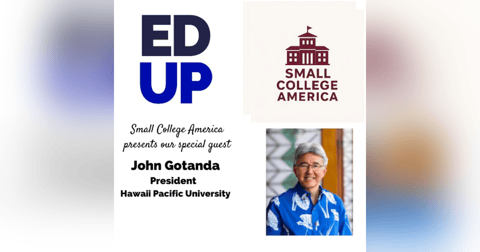
John Gotanda, President Hawaii Pacific University Leading a Global, Military-Connected University


Welcome to Small College America, a podcast dedicated to exploring the role and value of small colleges in the higher education landscape. I'm Kent Barnds, and I’m joined by my co-host, Dean Hoke.
John Gotanda is President of Hawaii Pacific University, the largest private university in Hawai'i, where he leads efforts to strengthen HPU's global identity, expand international partnerships, and advance student success across its diverse, multicultural community. Born and raised in Hawai'i, John brings both deep local roots and a strong international perspective to his leadership.
Before becoming president, he spent nearly three decades at Villanova University School of Law, serving in roles from Professor to Dean. As a scholar, John is internationally recognized for his work on damages in international law, with research cited by courts worldwide, including the U.S. Supreme Court.
He is a graduate of the University of Hawai'i at Mānoa and the William S. Richardson School of Law. And as a fun fact, John is an accomplished musician and songwriter whose work has been nominated for Hawai'i's NahHoku HanoHano Awards
- Question 1: Tell our audience about Hawaii Pacific University, the student profile, and what makes it different from other colleges? Are your undergraduate students the traditional 18-24 demographic, and what majors are they seeking?
- Question 2: John, the classic town-and-gown story in American higher education is about a college and its surrounding community becoming so intertwined that it's hard to say where one ends and the other begins. At Hawaii Pacific, it seems like you have a version of that story, but instead of a town, your partner is the U.S. military. Tell our audience about that relationship?
- Question 3: HPU attracts students from Hawaiʻi — both from high schools and military personnel based on the island — as well as the mainland and internationally. How do you think about balancing those different student markets, and has that mix changed in recent years
- Question 4: Many smaller private colleges struggle to differentiate themselves, but HPU has made some clear choices — a strong graduate portfolio, major programs in nursing, business, and professional fields. How deliberately has the university aligned its academic offerings with workforce needs in Hawaiʻi and the Pacific, and what led you to lean into that strategy?
- Question 5: You didn’t come up through the usual academic ladder; your career started in law, moved into legal education, and ultimately brought you back home to lead HPU. What did each of those chapters teach you about leadership that you rely on today as a university president?
- Question 6: Hawaiʻi Pacific operates in a unique space; an urban, globally connected university with strong professional and graduate programs. Looking five years ahead, what gives you the most confidence about HPU's future — and about the evolving role of smaller private universities in today's higher education landscape? Also John HPU’s future also includes new campus outside of Hawaii. Can you tell our audience about HPU and Las Vegas
Closing
John, thank you for joining us today and for giving our listeners such a clear window into Hawai‘i Pacific University — from its global, military-connected student community to the way the university has aligned its programs with workforce needs across the Pacific.
For those listening or viewing, if you'd like to learn more about Small College America, go to our web page at www.smallcollegeamerica.net, where you can find details on upcoming episodes, contact us, and suggest topics you’d like us to cover.
This episode of Small College America is made possible with underwriting support from Edu Alliance Group — a higher education consulting firm that champions small colleges and the communities they serve.
On behalf of our guest, President John Gotanda, my co-host Dean Hoke, and I, thank you for joining us.


