Faith, Mission, and the Future of Lutheran Higher Education with Rev Lamont Wells
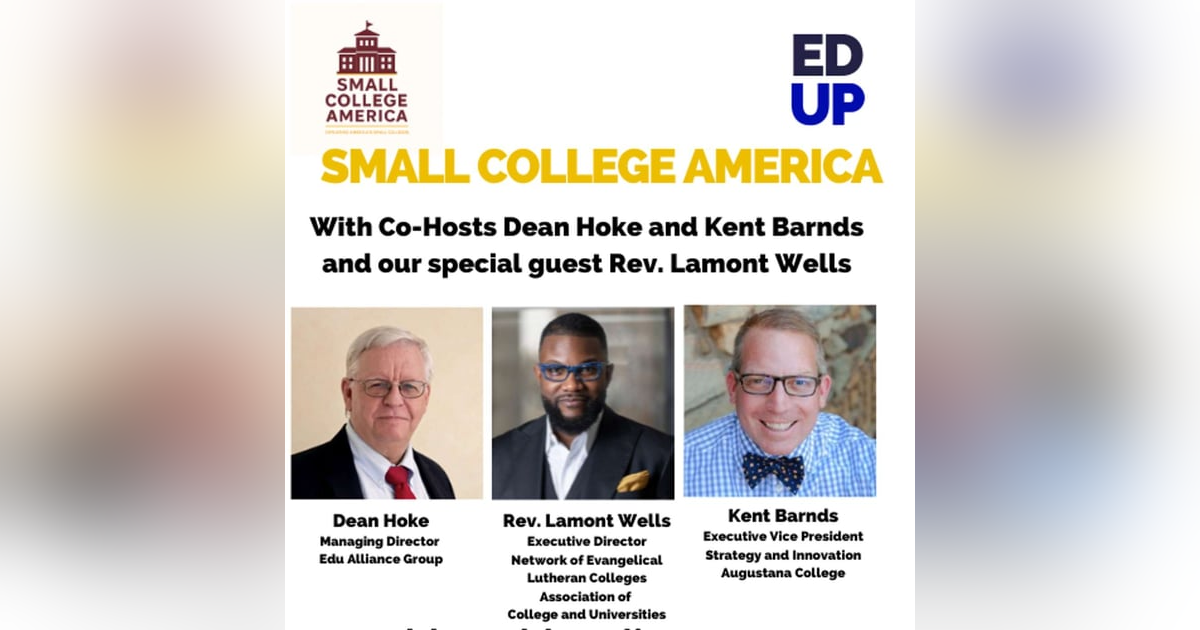


Welcome to Small College America, a podcast dedicated to exploring the role and value of small colleges in the higher education landscape. I'm Dean Hoke, and I’m joined by my co-host, Kent Barnds.
Kent: Our guest today is Rev. Lamont Anthony Wells, Executive Director of the Network of ELCA Colleges and Universities, an association representing 28 institutions connected to the Evangelical Lutheran Church in America. In this role, he works with presidents and campus leaders across the network to strengthen collaboration and support the mission of Lutheran higher education.
Earlier in his career, Rev. Wells served as Program Director for Campus Ministry in the ELCA, helping lead a network of faith and service communities on and near more than 240 college campuses across the country. He also served as a Lutheran campus pastor within the Atlanta University Center, one of the nation’s most prominent historically Black college communities.
He is a graduate of Morehouse College and later completed graduate studies in ministry and leadership at the Interdenominational Theological Center.
Question 1: Understand NECU
Dean: Rev. Wells, you serve as Executive Director of Higher Education, which represents 28 Lutheran-affiliated institutions. For listeners who may not be familiar with the network, could you describe NECU and the role it plays among those colleges and universities?
Question 2: Maintaining Identity
Kent: Many church-related colleges now enroll students from a wide range of backgrounds, and relatively few may be members of the founding denomination. How do Lutheran colleges maintain their identity and mission in that environment?
Question 3: Closures, Mergers, and Alliances
Dean: In recent years we’ve seen some small colleges close, merge, or explore new partnership models. Do you foresee similar developments among Lutheran colleges—perhaps closures, mergers, or new forms of alliances or coalitions?
Question 4: Relationship Between Church and College
Kent: Historically, many Lutheran colleges were founded by immigrant congregations and church communities. How would you describe the relationship today between the Evangelical Lutheran Church in America and its colleges?
Question 5: Collaboration Among Institutions
Dean: Discussion about the students attending member schools. What does he see? Check transcript
Question 6: Closing — Looking Ahead
Kent: As you look toward the next decade, what gives you the most optimism about the future of Lutheran higher education and the role these institutions can continue to play in American higher education?
Closing
Dean: Rev. Wells, thank you for joining us and for sharing your perspective on ELCA and the broader future of Lutheran higher education.
For those listening or viewing, if you'd like to learn more about Small College America, visit our website at www.smallcollegeamerica.net, where you can find details on upcoming episodes, contact us, and suggest topics you’d like us to cover. Also, I encourage you to subscribe to our series on your favorite podcast network,
This episode of Small College America is made possible with underwriting support from Edu Alliance Group — a higher education consulting firm that champions small colleges and the communities they serve.
On behalf of our guest, Revenue Lamont Wells, my co-host Kent Barnds, and I, thank you for joining us.


